Samara Botane has embraced a number of changes to lower our carbon footprint and hold to our commitment of stewardship and ecology. You can see the progress we’ve made here, including eco-policies we have put into place in the last several years.
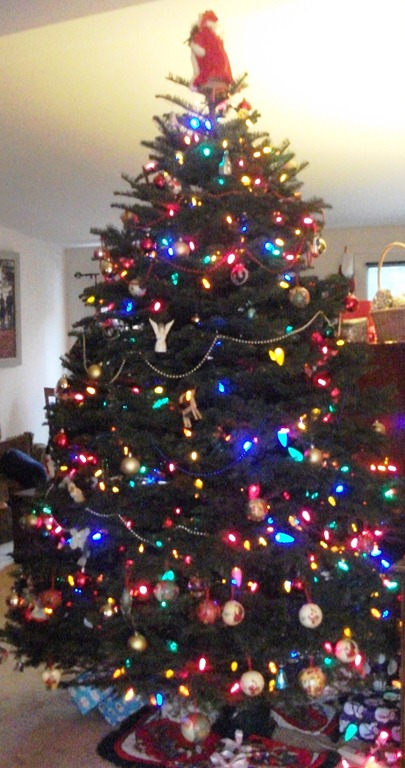 One of the small things we do personally each year has been to steam distill the twigs/needles from our Christmas tree. This trick was taught to me by my friend Carrol who is in tree care in Marietta GA. This gives us healthful aromatic products that serve us throughout the coming year, extending the precious benefits of the tree. How easily Westerners quickly discard their trees, perhaps with no realization of the years of growth and energy Nature has invested on our behalf. I hope you will consider exploring the additional uses and benefits, beyond the magical decoration for the holiday season, and save some of those branches to make delightful and healthful products for yourself and your family. This year, we will again be distilling the gorgeous Noble Fir that blessed our family this season and offering the hydrosol for sale after it has rested for a few weeks and passes scrutiny. I decided to look for other ideas to share, in order to savor our Christmas trees, long after the season.
Firs, Pines and Spruces are the most preferred Conifers for use in aromatherapy, and in most culinary applications. In this blogpost, I focus on Fir which includes Abies procera (Noble Fir) pictured, Abies grandis (Grand Fir), Abies balsamea (Balsam Fir), and Abies alba (White Fir). Olfactory attributes as described in perfumery for Firs are: strongly balsamic, slightly fatty-oily reminiscent of a pine forest and fruity-balsamic undertones. There are subtle olfactory nuances for each species. Chefs, like Rene Redzepi of Copenhagen describe Fir in culinary terms as having a pungent, citrusy flavor with green-minty backnotes.
If you do not have distillation equipment, you can make a simple aromatic herbal infusion by simmering the chopped needles (ratio: equal parts fresh water to needles, but make sure needles are covered completely by water) in a covered pot on the stove for 10-20 minutes, reduce heat and let cool in tightly covered pot to avoid loss of aromatic oils. Your infusion can be used to make simple herbal syrup of medium thickness (add equal parts of your infusion and organic sugar, bring to a boil stirring frequently, reduce heat and simmer until candy thermometer reaches at least 185 degrees, but no hotter than 220 degrees. You want to ensure the sugar is completely dissolved, but mixture does not turn to candy. Allow the syrup to cool gradually and do not refrigerate until entirely cool.
You can glaze a sponge cake for an unusual dessert sure to delight guests, or use this pungent syrup for a tasty fish or mussels dish to top rice. Native Americans often prepared fish wrapped in Pine needles, cooked over an open fire. You can grind needles with a mortar and pestle or coffee grinder dedicated to herbs and mix with other savory herbs, salts and peppers for a tasty mixture for soups and stews. Experiment and share your favorite ideas back with us!
The infusion, as well as the ground botanical, can be added to a bath along with sea salts and a few drops of Fir essential oil for a reviving soak. You can make an aromatic spray for your home or car with the infusion, again adding a few drops of the essential oil for strength. The dried botanical is also a lovely incense, burned on charcoal.
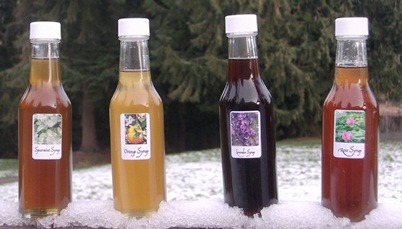 I made a few herbal syrups towards the end of the growing season. They were great gifts for friends and family. These include Spearmint, Orange, Lavender and Rugosa Rose. All but the Orange were from my garden. Pictured at right, they are made with organic sugar, with no added color, but strengthened with a few drops of the requisite essential oil. We are offering one of each as a bonus to our Facebook group members – the first four to submit orders of $100 or more with the Coupon Code will receive a 5-oz. bottle, randomly chosen. You can join the Samara Botane Facebook Group here to get details. Take a look at other aromatic offerings at our website here.
We will be holding another Treasure Hunt in the coming months, and watch for Rob’s upcoming report on aromaconnection exploring the affects of climate change on aromatic plants and crops.
I and the rest of the staff at Samara Botane welcome the New Year, bracing for its challenges. We wish you a very good twenty-eleven and remind you to use your aromatics, especially for stress and anxiety, sleeplessness and combating pollen and viral pollution.
Inhale Deeply and Breathe . . . Breathe . . . Peace.
Marcia
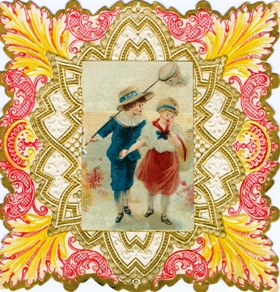 The oldest valentine in existence is thought to be a poem written by Charles, Duke of Orleans to his wife while he was imprisoned in the tower of London in 1415. Valentine greetings and tokens of affection were popular as far back as the Middle Ages, although written valentines didn’t appear until after 1400. The first commercial valentine in the United States is attributed to Esther A. Howland who made elaborate creations with lace, ribbons and colorful pictures, known as ‘scrap’. The scanned image at right is one of several elaborate, lacy valentines belonging to my long deceased great grandmother.
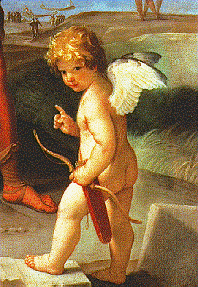 In Roman mythology, Cupid (meaning ‘desire’) is the god of erotic love and beauty, aka Amor, and son of goddess Venus and god Mercury. We have exploited this young deity in art, literature, confection, adornment and perfume at this time of year, some would say to excess. And, while we moderns are probably not going to participate in the elaborate ancient celebration of